Only a tiny fraction of the Earth's water is fresh water that people can easily use. This topic covers the water cycle, where our fresh water comes from, how it is made safe to drink, why some places have far less of it than others, and two big engineering solutions: desalination and multipurpose dams.
Water moves continuously between the oceans, the atmosphere and the land. This movement is called the water cycle. Water is held in stores and moves between them by transfers (also called flows).
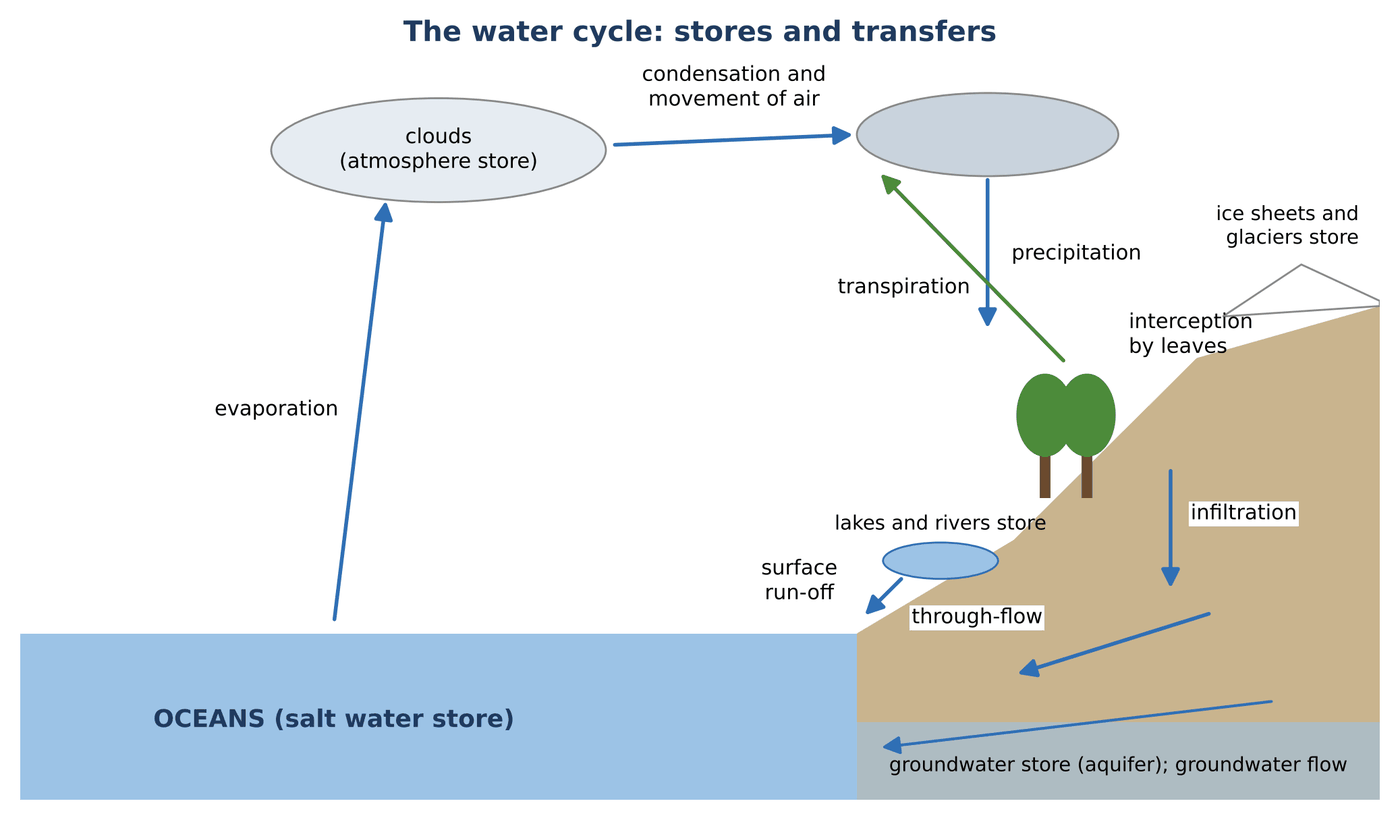
| Store | Type | Notes |
|---|---|---|
| Oceans | Salt water | By far the largest store; holds about 97% of all water on Earth |
| Ice sheets and glaciers | Fresh water | The largest store of fresh water, mainly in Antarctica and Greenland |
| Ground water | Fresh water | Water in the pore spaces and cracks of permeable rock (aquifers) |
| Atmosphere | Fresh water | Water vapour and clouds |
| Lakes and rivers | Fresh water | A very small store, but the most easily used by people |
| Transfer | What happens |
|---|---|
| Evaporation | Liquid water is heated by the Sun and changes into water vapour |
| Transpiration | Water vapour is lost from plant leaves |
| Condensation | Water vapour cools and turns back into tiny droplets, forming clouds |
| Precipitation | Water falls from clouds as rain, snow, sleet or hail |
| Interception | Precipitation is caught by leaves and stems before reaching the ground |
| Surface run-off | Water flows over the surface of the ground into rivers and the sea |
| Infiltration | Water soaks into the soil from the surface |
| Through-flow | Water moves sideways through the soil towards rivers |
| Ground water flow | Water moves slowly through permeable rock towards rivers and the sea |
You may be asked to interpret a water cycle diagram, for example to identify a labelled transfer, or to explain how a change such as deforestation affects it. Removing trees reduces interception and transpiration, so more water reaches the ground quickly and surface run-off increases.
- 3.1.2 Sources of fresh water used by people
- 3.1.3 The world's oceans
- 3.1.4 Potable water
- 3.1.5 Water treatment
- 3.1.6 Availability of potable water in different parts of the world
- 3.1.7 Desalination
- 3.1.8 Benefits and limitations of desalination
- 3.1.9 Uses of a multipurpose dam
- 3.1.10 Benefits and limitations of a multipurpose dam
- Exam practice: 9 practice questions
- 2 exemplar answers with full model answers and mark breakdowns
- Where students commonly lose marks