The world's population grew from about 2.5 billion in 1950 to more than 8 billion today. This topic explains what makes populations grow or shrink, and the impacts of rapid population growth, especially in cities.
A population changes because of births, deaths and migration. Natural increase is the birth rate minus the death rate.
A country has a birth rate of 24 per 1000 people per year and a death rate of 8 per 1000 per year. Natural increase = 24 − 8 = 16 per 1000 per year, which is 1.6% per year.
A total fertility rate of about 2.1 is needed for a population to replace itself in the long term (ignoring migration). Birth rates are high where children are needed to work on farms or support parents in old age, where infant mortality is high, where women have less access to education and contraception, and where religion or culture values large families. Birth rates fall as women's education, incomes and healthcare improve.
Death rates fall and life expectancy rises with better healthcare, vaccination, clean water and sanitation, a reliable food supply and improved living conditions.
| Term | Meaning |
|---|---|
| Migration | The movement of people from one place to another to live, either within a country or between countries |
| Emigration | Leaving a country to live in another |
| Immigration | Arriving in a country to live there |
| Push factors | Negative features of the place of origin that encourage people to leave |
| Pull factors | Attractive features of a destination that encourage people to move there |
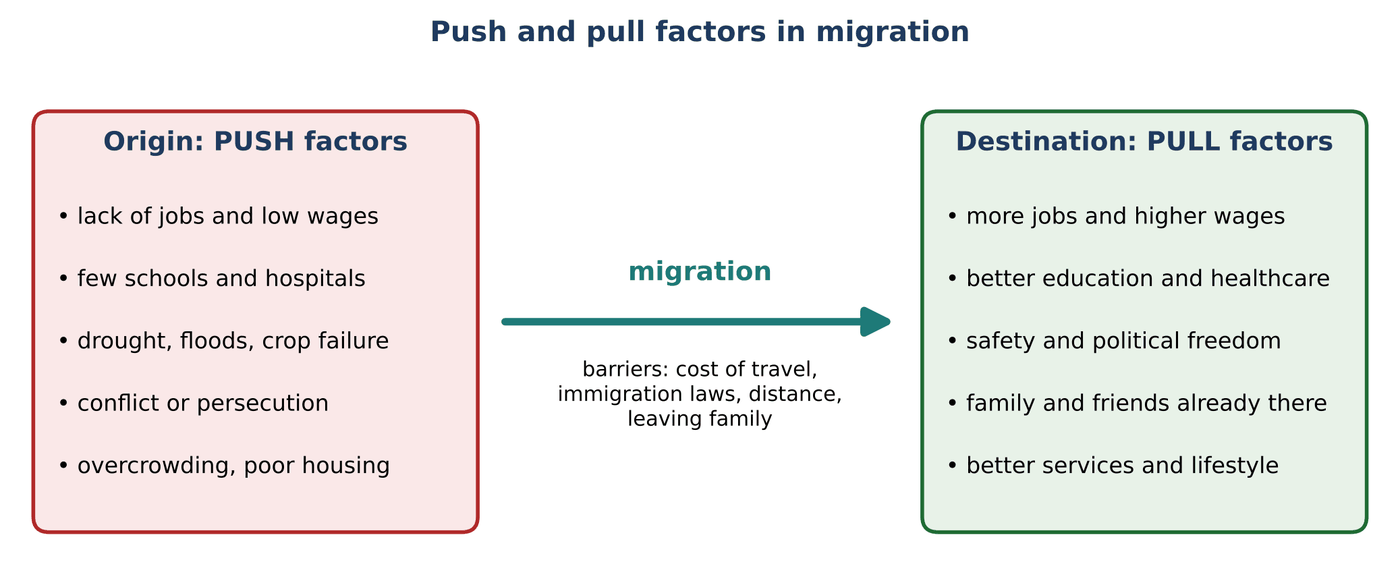
Rural-urban migration is the movement of people from the countryside to towns and cities. Push factors include lack of jobs, low farm incomes, drought and poor services; pull factors include jobs in factories and services, higher wages, schools and hospitals. Some people also move from cities to rural areas (urban-rural migration), for example to retire or for a quieter lifestyle.
Urbanisation happens through rural-urban migration and natural increase in cities (many migrants are young adults who then have children). It is fastest today in Asia and Africa.
- 7.2.2 Impacts of human population growth
- Exam practice: 8 practice questions
- 1 exemplar answer with a full model answer and mark breakdown
- Where students commonly lose marks