The atmosphere is a thin layer of gases that protects life on Earth and keeps the planet warm. This topic covers its structure and composition, the difference between weather and climate, and the natural greenhouse effect.
The atmosphere is divided into layers according to how temperature changes with height. In order from the ground upwards they are the troposphere, stratosphere, mesosphere and thermosphere.
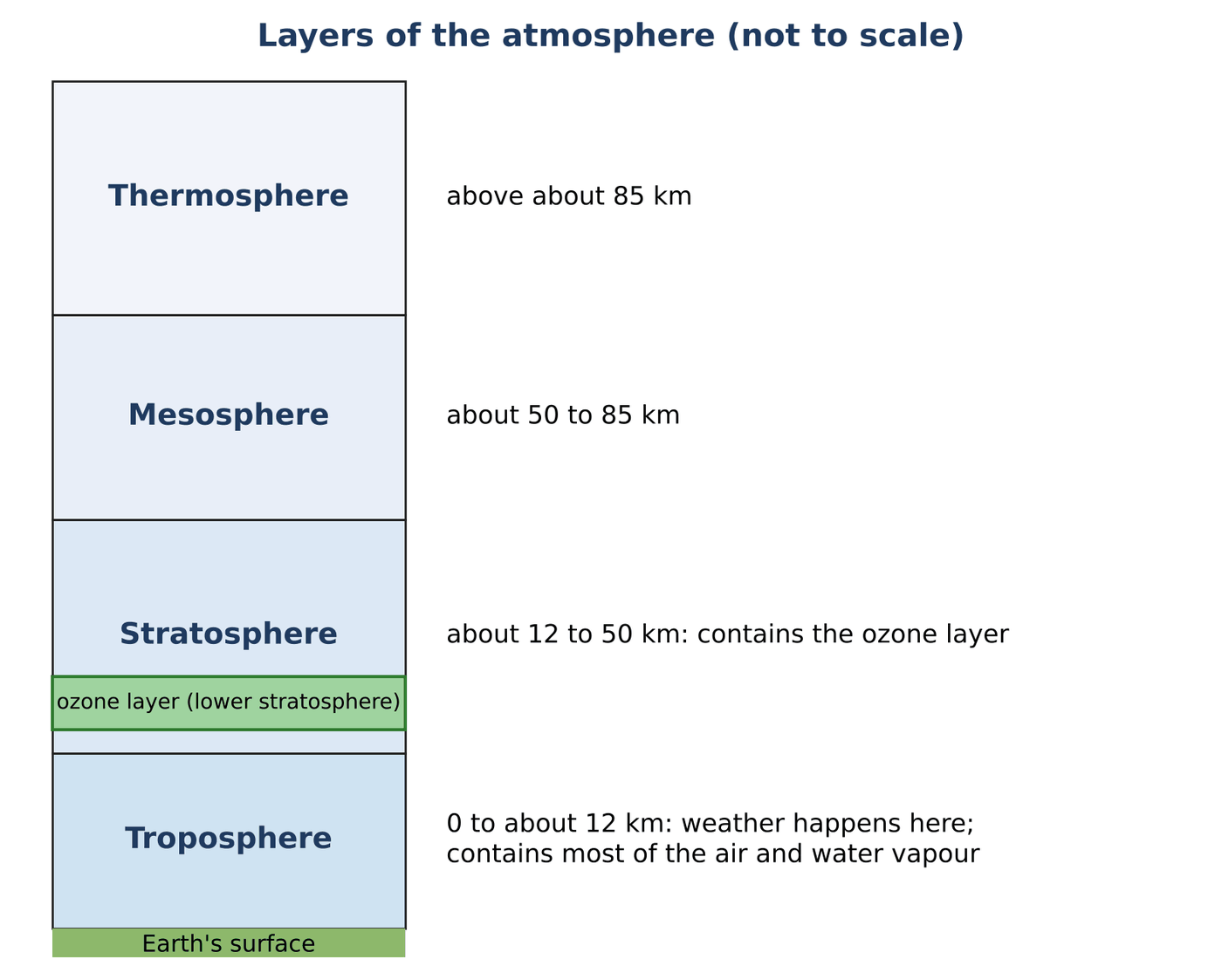
| Layer | Approximate height | Key features |
|---|---|---|
| Troposphere | 0 to about 12 km (lower at the poles, higher at the Equator) | Contains most of the mass of the air and almost all water vapour; clouds and weather happen here; temperature falls with height |
| Stratosphere | About 12 to 50 km | Contains the ozone layer in its lower part; temperature rises with height because ozone absorbs ultraviolet radiation; jet aircraft fly near its base |
| Mesosphere | About 50 to 85 km | Temperature falls with height; meteors burn up here |
| Thermosphere | Above about 85 km | Very thin air; temperature rises with height; the International Space Station orbits in this layer |
The ozone layer is in the lower stratosphere. It absorbs most of the Sun's harmful ultraviolet (UV) radiation (see 4.4).
| Gas | Approximate percentage of dry air |
|---|---|
| Nitrogen | 78% |
| Oxygen | 21% |
| Argon | just under 1% |
| Carbon dioxide | about 0.04% |
Air also contains a variable amount of water vapour, from almost none in cold deserts to about 4% in warm, humid places. Although carbon dioxide and water vapour are present in small amounts, they are very important as greenhouse gases.
- 4.1.2 Climate
- 4.1.3 The natural greenhouse effect
- Exam practice: 6 practice questions
- 1 exemplar answer with a full model answer and mark breakdown
- Where students commonly lose marks