HL only This topic is for Higher Level students.
Data has become a raw material in its own right — powerful for decisions, valuable to criminals, and full of ethical choices.
Guiding question
When a business can know almost everything about its customers and employees, what should it choose not to do with that knowledge?
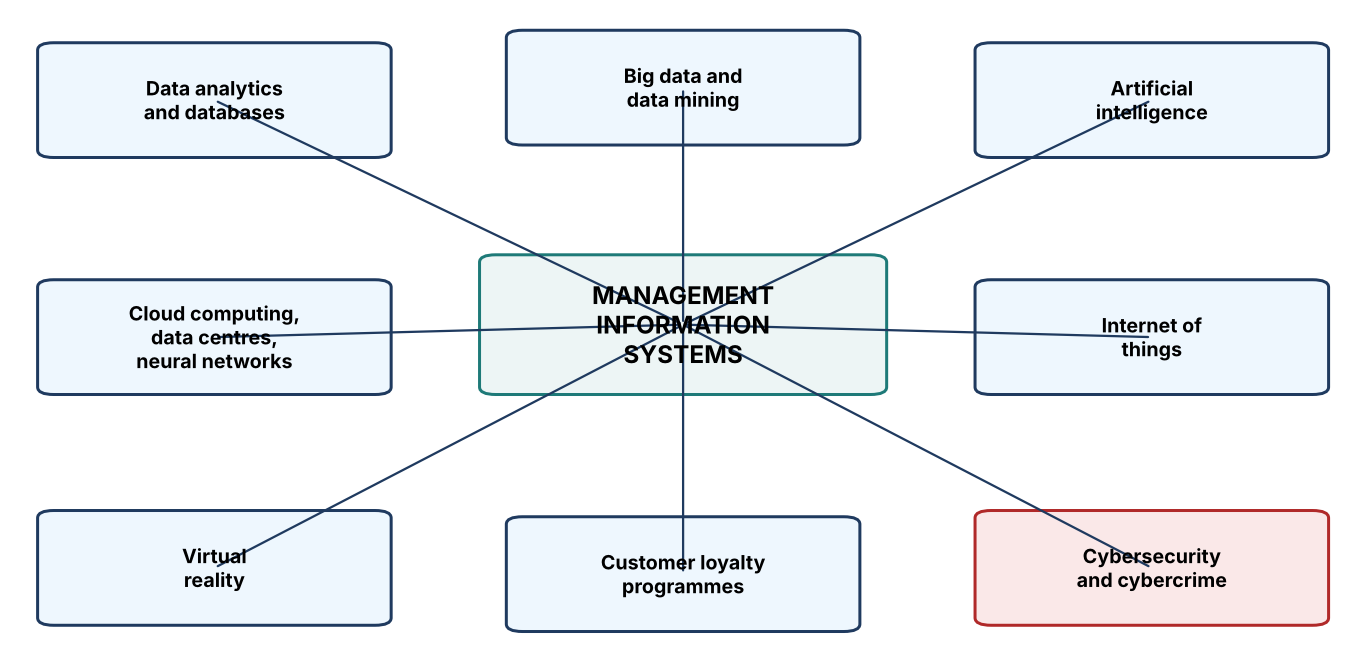
- I can describe data analytics, databases, cybersecurity and cybercrime
- I can explain critical infrastructures (artificial neural networks, data centres, cloud computing), virtual reality, the internet of things, artificial intelligence and big data
- I can evaluate customer loyalty programmes, the use of data to monitor employees (digital Taylorism) and data mining
- I can evaluate the benefits, risks and ethical implications of management information systems for decision-making and stakeholders
HL only
This entire topic is HL only. Several items are assessed at AO1 (know and describe) or AO2 (explain); the AO3 items — loyalty programmes, employee monitoring, data mining and the overall evaluation — are where 10-mark questions come from.
A database is an organised, searchable collection of data stored electronically — customer records, stock levels, employee files.
Cybercrime is criminal activity carried out using computers or networks — hacking, data theft, ransomware, phishing and online fraud.
Cybersecurity is the set of technologies, processes and practices that protect systems, networks and data from cyberattacks and unauthorised access.
As businesses store more valuable data, they become bigger targets. A cyberattack can halt operations, expose customer data, trigger fines under data-protection laws (India's Digital Personal Data Protection Act 2023, the EU's GDPR) and destroy trust. Cybersecurity spending — firewalls, encryption, staff training, backups and incident response plans (5.7) — is now a core operating cost.
- 5.9.2 Critical infrastructures and advanced technologies (HL only)
- 5.9.3 Customer loyalty programmes (HL only)
- 5.9.4 The use of data to manage and monitor employees; digital Taylorism (HL only)
- 5.9.5 The use of data mining to inform decision-making (HL only)
- 5.9.6 Benefits, risks and ethical implications of MIS (HL only)
- Exam practice: 5 questions with mark allocations
- 2 exemplar answers with model answers and examiner-style commentary
- Where students commonly lose marks