HL only This topic is for Higher Level students.
Every plan in the business rests on one guess about the future — how much will we sell?
Guiding question
If the future cannot be known, why do businesses spend so much effort predicting it?
- I can explain what sales forecasting is and how a trend can be identified from past data
- I can evaluate the benefits and limitations of sales forecasting
HL only
This entire topic is HL only. The guide assesses it at AO3: you must be able to judge the benefits and limitations of forecasting. Simple trend methods are shown below so that the judgement rests on understanding; the formal quantitative tool is simple linear regression (see the Toolkit box).
Past sales usually mix an underlying trend with seasonal variations (festival peaks, monsoon dips), cyclical variations (booms and recessions) and random variations (a strike, a viral post). Averaging consecutive periods — a moving average — smooths out short-term fluctuations so the trend shows, and the trend can then be extended into the future.
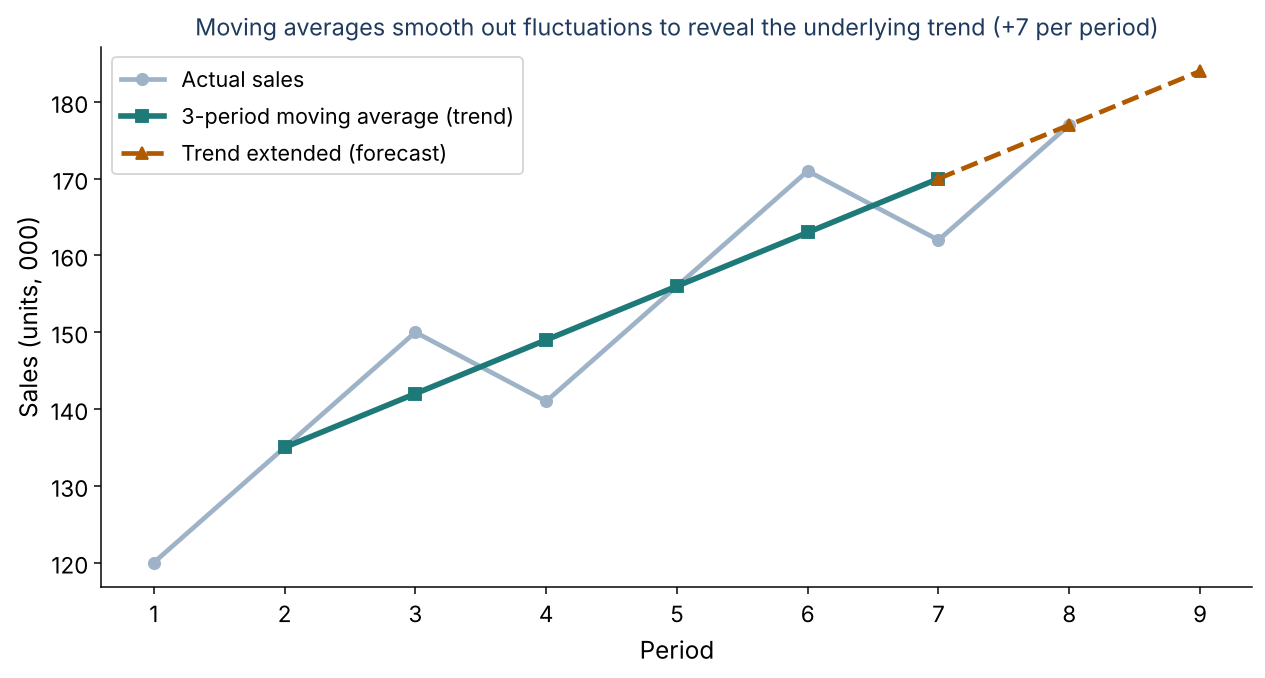
A snack maker's sales (000 units) over eight periods: 120, 135, 150, 141, 156, 171, 162, 177. 3-period moving average for period 2 = (120 + 135 + 150) ÷ 3 = 135 → Period 3 = (135 + 150 + 141) ÷ 3 = 142; period 4 = 149; period 5 = 156; period 6 = 163; period 7 = 170 → The trend rises by 7 (000 units) per period, so the trend forecast for period 9 ≈ 170 + 7 + 7 = 184
The raw data zig-zag, but the moving average reveals a steady upward trend that can be projected.
- Operations planning — production, capacity and stock levels can be set to expected demand (avoiding stockouts and waste)
- Workforce planning — recruitment, overtime and seasonal hiring can be arranged in advance (2.1)
- Financial planning — forecasts feed budgets (3.9) and cash flow forecasts (3.7), and support applications for finance
- Marketing planning — promotions can be timed to seasonal peaks or used to lift forecast dips
- Coordination — every department works to the same assumptions about the future
- The future may not resemble the past — trends break with new competitors, technology, recessions, pandemics or regulation
- Data quality — forecasts built on incomplete or biased data inherit their errors
- Unsuitable for new products — there is no past data to extend, so forecasts lean on research and judgement
- Human bias — sales teams may forecast low to beat targets; managers may forecast high to win budgets
- Cost and time — sophisticated forecasting needs expertise and software that small firms may lack
A retailer forecasts strong festival sales from the past trend → it orders stock and hires seasonal staff in advance → if the forecast is accurate, it avoids stockouts and earns peak profits → if a recession hits, unsold stock ties up cash and must be discounted → the value of the forecast depends on how the business responds when reality diverges
Forecasts are always wrong in detail; their value lies in being usefully wrong. A forecast makes assumptions explicit, so managers can see early when reality diverges and adjust. Good practice therefore combines methods (trend analysis plus market research plus expert judgement), uses ranges rather than single numbers, updates forecasts frequently, and builds in flexibility — buffer stock, flexible staff, contingency plans. Reliability depends on market stability: forecasting toothpaste sales is far easier than forecasting demand for a new technology.
Forecasting is the attempt to plan for change before it happens. The guide's TOK question — are predictions in the human sciences inevitably unreliable? — has a practical answer: they are unreliable in detail but still valuable, because a business that plans with an imperfect forecast adjusts faster than one that does not plan at all.
Toolkit: Simple linear regression (HL)
Simple linear regression fits a straight line through past data (for example, sales against time, or sales against advertising spending) and uses its equation to predict future values. The correlation coefficient shows how closely the data follow the line. Regression is only as good as the assumption that the relationship will continue — and correlation does not prove causation.
- Exam practice: 5 questions with mark allocations
- 2 exemplar answers with model answers and examiner-style commentary
- Where students commonly lose marks