Level: SL and HL. Sections marked HL only are for Higher Level students.
Marketing starts with a choice of direction: build what you can make, or make what customers will buy — and then measure where you stand in the market.
Guiding question
Should a business listen to its customers or lead them?
- I can distinguish market orientation from product orientation
- I can calculate and interpret market share and market growth (AO4)
- HL: I can evaluate the importance of market share and market leadership
A market-oriented business starts from customer needs: it researches what customers want and designs products to meet them.
A product-oriented business starts from its own products and capabilities: it focuses on making the best product it can and then looks for customers to buy it.
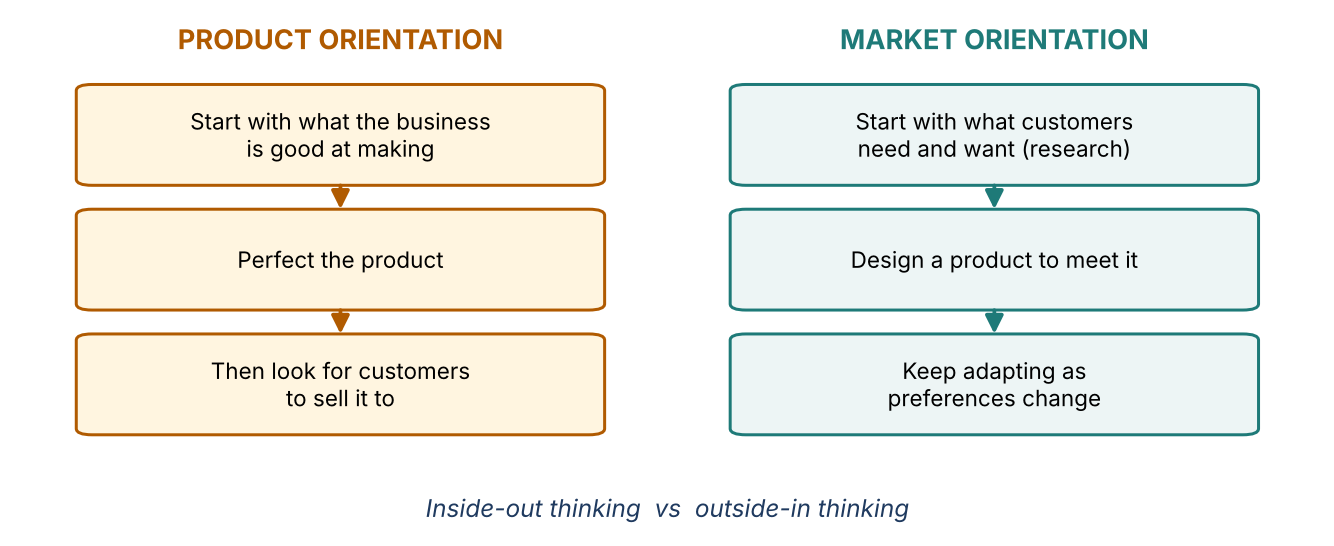
| Product orientation | Market orientation | |
|---|---|---|
| Starting point | The firm's skills, technology and products | Customers' needs, wants and behaviour |
| Role of research | Limited — mainly technical R&D Product orientation | Central — continuous market research Market orientation |
| Strengths | Quality, innovation, engineering excellence; can create markets customers did not imagine | Products people actually want; faster response to changing tastes; lower risk of failure |
| Risks | Excellent products nobody needs; slow to notice changing tastes | Costly research; incremental 'me-too' products; may chase every trend |
| Suits | Technology breakthroughs, specialist engineering, luxury craft | Fast-moving consumer goods, services, competitive markets |
Customer tastes shift (for example, towards healthier snacks) → a market-oriented firm detects the change through research and redesigns its range → a product-oriented firm keeps perfecting yesterday's product → sales drift to the rival that adapted → orientation decides who notices change first
Few successful businesses sit at either extreme. Pure product orientation risks the 'better mousetrap' fallacy — excellence nobody asked for — while pure market orientation struggles to produce breakthroughs, because customers can rarely describe products that do not yet exist. The best answer depends on the market's pace and the nature of the product: research-driven adaptation suits consumer markets; capability-led invention suits technology frontiers, where the firm must still test that its invention solves a real problem.
- 4.1.2 Market share
- 4.1.3 Market growth
- 4.1.4 The importance of market share and market leadership (HL only)
- Exam practice: 5 questions with mark allocations
- 2 exemplar answers with model answers and examiner-style commentary
- Where students commonly lose marks