Level: SL and HL. Sections marked HL only are for Higher Level students.
What makes people work hard — money, needs, fairness, purpose? The theories disagree in instructive ways, and businesses pay for the difference every month.
Guiding question
Can a business ever really know what motivates its employees — and what happens when it guesses wrong?
- I can explain and evaluate the motivation theories of Taylor, Maslow and Herzberg
- HL: I can explain and evaluate McClelland's acquired needs theory, Deci and Ryan's self-determination theory, and equity and expectancy theory
- HL: I can calculate and interpret labour turnover, and explain types of appraisal and methods of recruitment
- I can analyse financial and non-financial rewards and types of training, and recommend a motivation package for a given situation
F. W. Taylor (early 1900s) assumed workers are motivated chiefly by pay. Managers should scientifically study each job, find the one best method, select and train workers for it, and pay by output — piece rates — so effort translates directly into earnings. Taylor's methods raised productivity dramatically in factories, and his logic survives in gig-economy pay-per-delivery. But treating workers as economic machines ignores social needs, breeds monotony and resistance, and fails wherever output cannot be counted (most service and knowledge work).
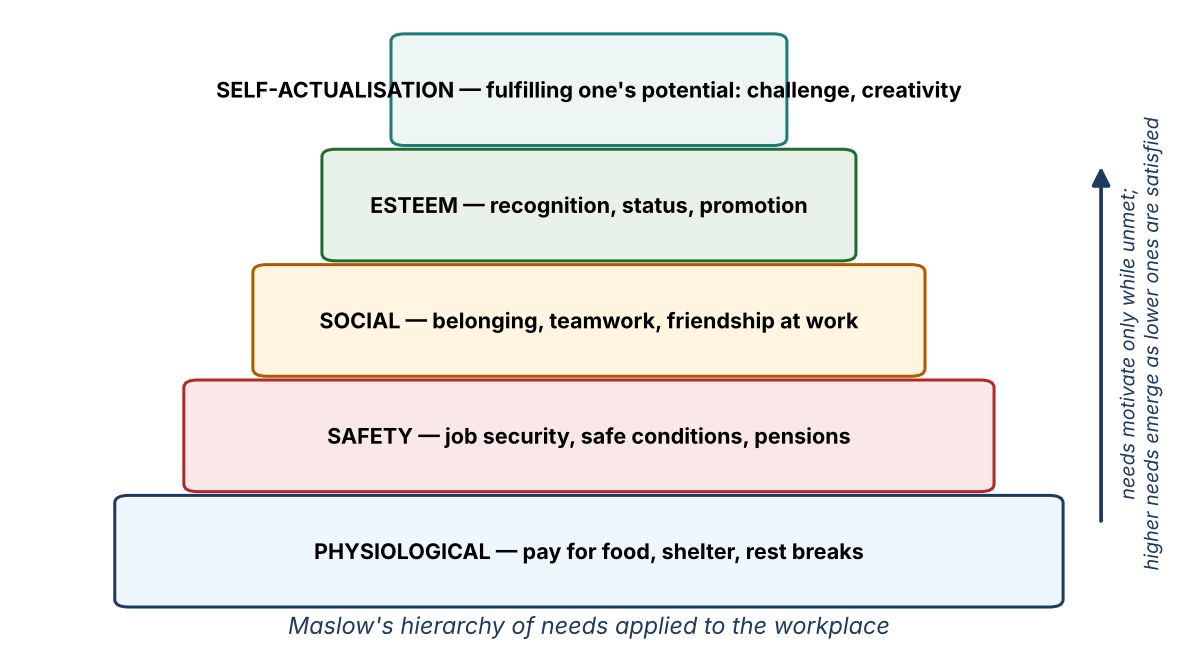
Abraham Maslow argued people are motivated by five levels of need — physiological, safety, social, esteem and self-actualisation — and that a satisfied need no longer motivates: once pay covers necessities and the job is secure, employees seek belonging, recognition and growth. The theory tells managers to diagnose which level an employee is at. Its limits: people do not climb one level at a time, levels are hard to identify from outside, and the hierarchy reflects one culture's assumptions.
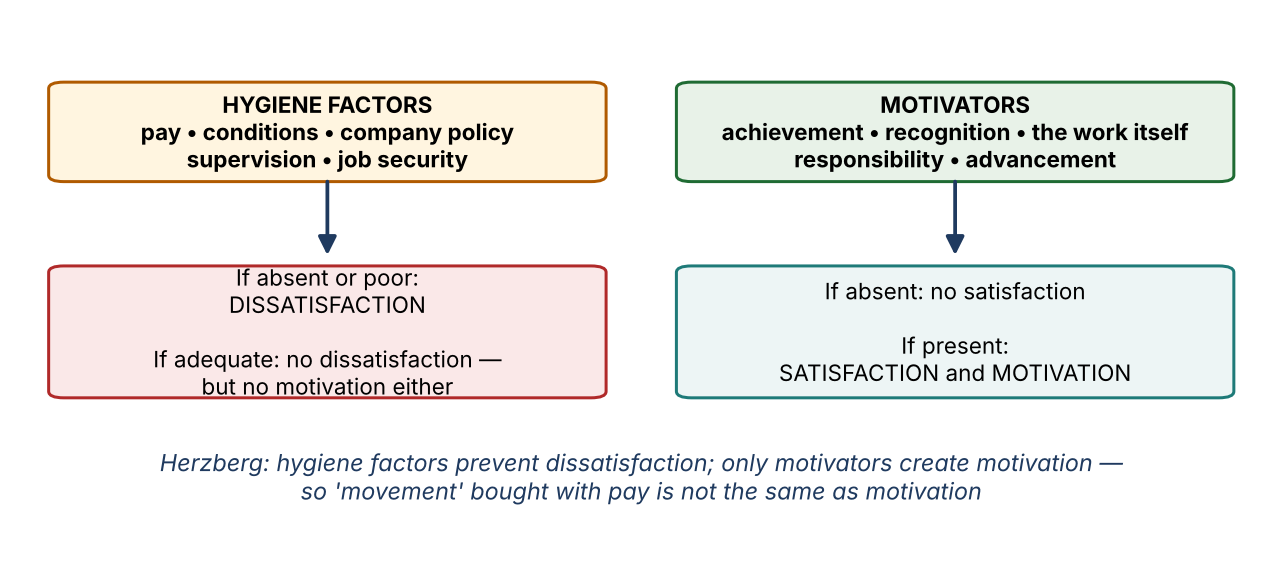
Frederick Herzberg found that the factors causing dissatisfaction are not the opposites of those causing satisfaction. Hygiene factors — pay, conditions, company policy, supervision, security — cause dissatisfaction when poor, but adequate hygiene merely brings workers to neutral. Only motivators — achievement, recognition, the work itself, responsibility, advancement — generate real satisfaction and effort. Hence his prescription: enrich jobs, don't just sweeten pay. He also distinguished movement (working to gain rewards or avoid punishment) from motivation (working because the work itself matters to you).
A call centre raises pay 10% to fix low morale → dissatisfaction falls briefly (hygiene improved) → but the work remains monotonous and unrecognised (no motivators added) → within months effort and turnover return to old levels → the firm has bought movement, not motivation — exactly Herzberg's prediction
The three theories answer different questions: Taylor, how to extract measurable effort; Maslow, which needs to satisfy next; Herzberg, why satisfied-enough workers still coast. None is universally 'right' — piece rates still work for countable, independent tasks, while enrichment works for work people can care about. Examiners reward matching theory to the workforce in the stem, not reciting all three.
- 2.4.2 Motivation theories: McClelland, Deci and Ryan, equity and expectancy (HL only)
- 2.4.3 Labour turnover (HL only)
- 2.4.4 Types of appraisal (HL only)
- 2.4.5 Methods of recruitment; internal and external recruitment (HL only)
- 2.4.6 Types of financial rewards
- 2.4.7 Types of non-financial rewards
- 2.4.8 Types of training
- Exam practice: 5 questions with mark allocations
- 2 exemplar answers with model answers and examiner-style commentary
- Where students commonly lose marks