Level: SL and HL
Money enters a business for two very different jobs — buying the future, and paying for today.
Guiding question
Why does it matter whether a rupee is spent on a machine or on the electricity that runs it?
- I can explain the role of finance for businesses
- I can distinguish capital expenditure from revenue expenditure and classify examples of each
- I can explain why the distinction matters for the accounts and for financing decisions
Every business needs finance at every stage of its life: to start up (premises, equipment, licences), to operate (wages, materials, bills), to grow (new outlets, machinery, acquisitions) and to survive shocks (covering losses, refinancing debts). The finance function manages where this money comes from (topic 3.2) and where it goes — and the first distinction it draws is between two kinds of spending.
Revenue expenditure is spending on the day-to-day running of the business — costs used up within the year, such as wages, rent, raw materials, fuel, insurance and utility bills.
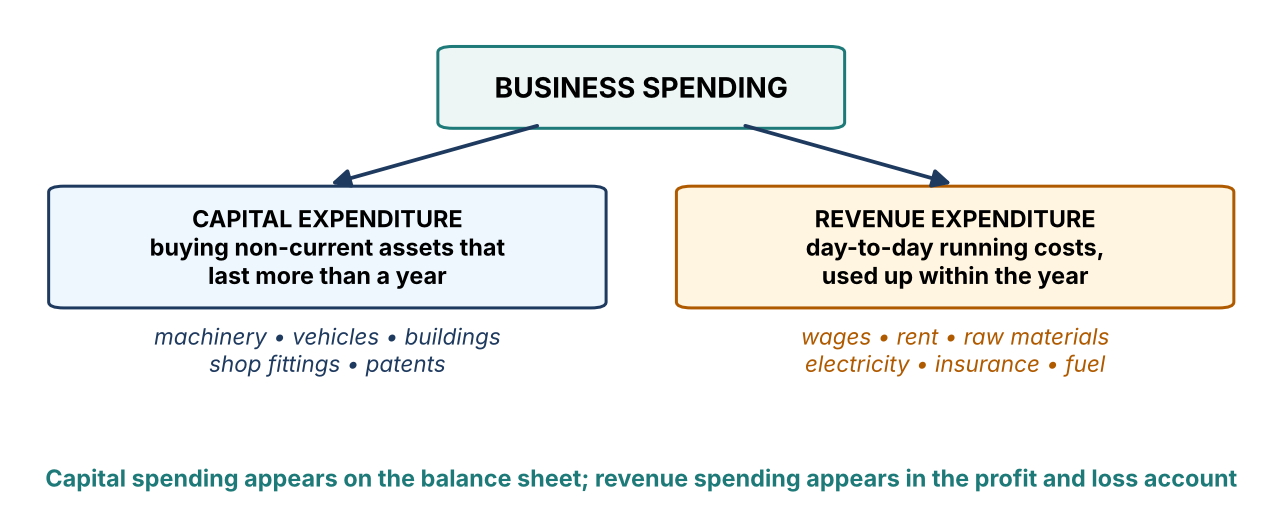
| Capital expenditure | Revenue expenditure | |
|---|---|---|
| Buys | Non-current assets kept for years | Goods and services used up quickly |
| Purpose | Builds the capacity to trade | Keeps current trading going |
| Appears in | The balance sheet (as assets) | The profit and loss account (as costs) |
| Usually financed by | Long-term sources (loans, share capital, retained profit) | Short-term sources (sales revenue, trade credit, overdraft) |
| Examples | Machinery, vehicles, property, patents | Wages, rent, materials, electricity, marketing |
A business confuses the two and funds a long-term asset with a short-term overdraft → the asset earns its returns over years, but the overdraft demands repayment (and high interest) within months → cash drains out faster than the asset generates it → a fundamentally sound investment creates a liquidity crisis → matching the term of finance to the life of the spending is the first rule of financial management
The boundary can blur — a ₹40,000 laptop is technically capital expenditure but many small firms treat small purchases as revenue spending for simplicity, and repairs (revenue) shade into improvements (capital). The classification matters because it changes reported profit: treating capital spending as a cost would crush this year's profit, while treating running costs as assets would flatter it — which is why accounting rules police the line (a theme that returns with depreciation in 3.4 and 'creative accounting' debates).
Capital expenditure is where sustainability commitments become real: solar panels, efficient machinery and cleaner processes all demand money now for benefits spread over years. Businesses that judge such spending only by this year's profit will systematically underinvest in their own future — the finance topics that follow (investment appraisal in particular) exist to judge it properly.
- Exam practice: 5 questions with mark allocations
- 2 exemplar answers with model answers and examiner-style commentary
- Where students commonly lose marks