Level: SL and HL
Before a business can manage its money, it must know which costs move with output, which do not, and where every rupee of revenue comes from.
Guiding question
Why do two businesses with the same revenue survive so differently when sales fall?
- I can classify costs as fixed, variable, direct and indirect, with examples
- I can calculate total revenue and explain a business's revenue streams
- I can analyse how cost structure affects a business's risk and decisions
Variable costs change directly with output — raw materials, packaging, piece-rate wages. Direct costs can be clearly traced to a particular product, department or activity — the flour in a bakery's bread, a project team's wages.
Indirect costs (overheads) cannot be traced to one product and are shared across the business — the bakery's rent, the head office, marketing, administration.
The two classifications answer different questions. Fixed/variable asks how costs behave when output changes — the key to break-even (5.5) and risk. Direct/indirect asks what each product really costs — the key to pricing and to judging which products pay their way. A cost can be in both camps: the bakery's flour is variable and direct; its rent is fixed and indirect; a product manager's salary is fixed but direct to her product line.
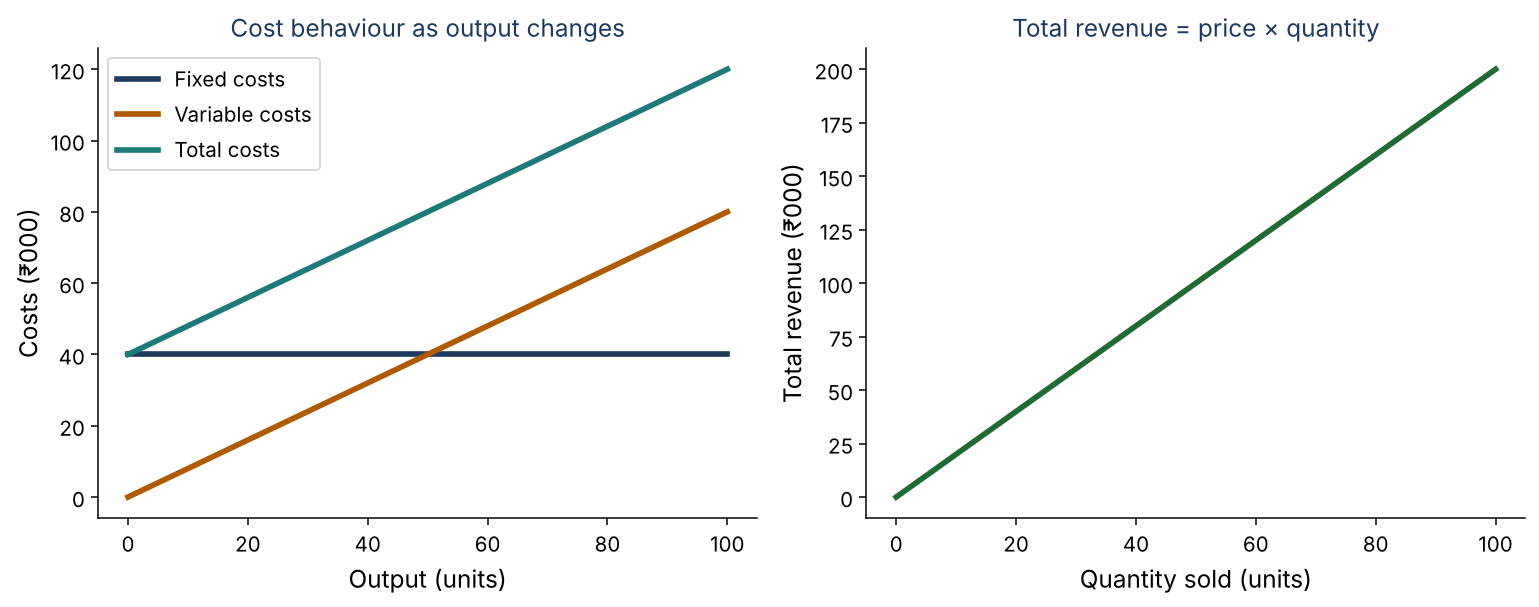
A phone-case maker has fixed costs of ₹40,000 per month and variable costs of ₹80 per case.
Total costs at 1,000 cases = 40,000 + (80 × 1,000) = ₹1,20,000 → Total costs at 2,000 cases = 40,000 + (80 × 2,000) = ₹2,00,000 → Average cost falls from ₹120 to ₹100 per case as fixed costs spread over more units
Doubling output raised total costs by only two-thirds — spreading fixed costs is why utilisation matters so much to profit.
A business has high fixed costs (an airline, a cinema, a software firm) → when sales rise, extra revenue adds almost pure profit — fixed costs are already paid → but when sales fall, those fixed costs keep arriving regardless → profit swings violently in both directions → high fixed costs mean high operating risk, and pricing to fill capacity becomes critical
- 3.3.2 Total revenue and revenue streams
- Exam practice: 5 questions with mark allocations
- 2 exemplar answers with model answers and examiner-style commentary
- Where students commonly lose marks