Whatever the business, management work can be grouped into four traditional functions, applied continuously and together:
| Function | What it involves | Example: launching a new café branch |
|---|---|---|
| Planning | Setting objectives and deciding the actions, resources and timescales to achieve them | Set the opening date, sales target and budget for the branch |
| Organising | Arranging resources and tasks: who does what, with what, reporting to whom | Hire and rota staff, order equipment, assign the fit-out tasks |
| Directing | Leading, instructing and motivating people to carry out the plan | Brief the team daily, coach the new baristas, keep energy high |
| Controlling | Measuring performance against the plan and correcting deviations | Compare weekly sales and costs with target; act on the gaps |
Henri Fayol, a French industrialist writing in 1916, was the first to define management as a set of functions that could be taught. His five functions are the traditional four above plus coordinating — harmonising the work of different people and departments so their efforts combine rather than collide. (Fayol's original term for directing was commanding.) Fayol saw these functions as universal: every manager, in any industry, performs all five.
Henry Mintzberg studied what managers actually do all day and found not orderly functions but a whirl of short, interrupted activities. He grouped them into ten roles in three categories:
| Category | Roles | The manager as… |
|---|---|---|
| Interpersonal (dealing with people) | Figurehead; Leader; Liaison | the symbolic face at ceremonies; the motivator of the team; the networker linking the unit to outsiders |
| Informational (dealing with information) | Monitor; Disseminator; Spokesperson | the gatherer of internal and external information; the passer-on of it to the |
| Category | Roles | The manager as… |
| team; the voice of the unit to the outside | ||
| Decisional (making decisions) | Entrepreneur; Disturbance handler; Resource allocator; Negotiator | the initiator of improvement and change; the firefighter in crises; the divider of budgets, people and time; the bargainer with suppliers, unions and other departments |
Fayol describes what management is for; Mintzberg describes what managing feels like. Together they show a complete manager needs both the discipline of the functions and the agility of the roles.
- they turn objectives into coordinated action — without management, individual effort pulls in different directions
- they allocate scarce resources (money, people, time) to their most productive uses
- they motivate: a capable manager lifts the effort and retention of a whole team; a poor one is a leading cause of resignations
- they control performance, catching falling quality or rising costs early
- they drive change and improvement — spotting problems and opportunities and acting on them (Mintzberg's entrepreneur role)
- measurable results: well-managed businesses show higher productivity, lower labour turnover and better profitability than badly managed rivals in the same industry
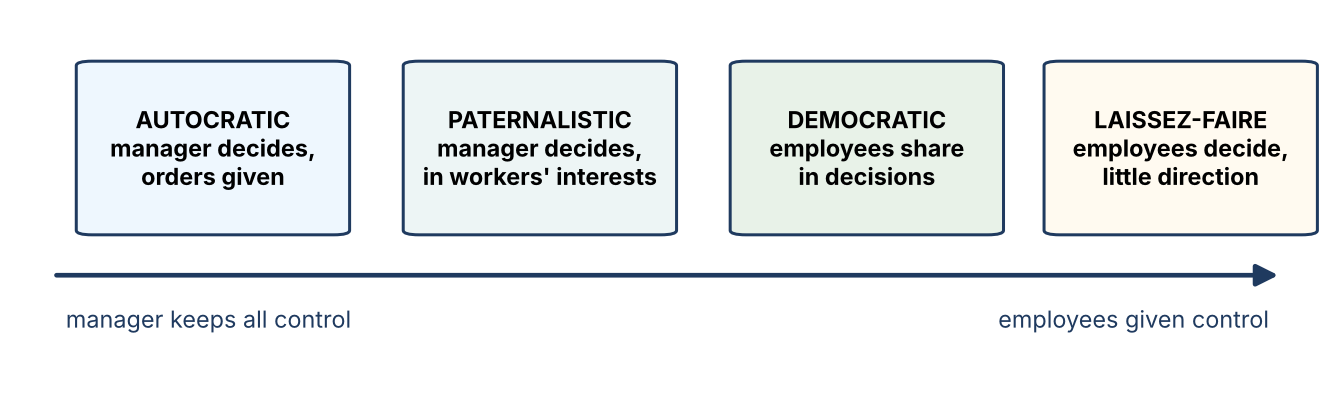
| Style | How decisions are made | Advantages | Disadvantages |
|---|---|---|---|
| Autocratic | The manager decides alone and issues instructions; communication is one- way, downwards | Fast decisions; clear in crises and with untrained staff; consistent standards | Demotivates skilled staff; no use of employees' ideas; everything depends on the manager |
| Paternalistic | The manager decides | Staff feel cared for; loyalty | Still no real voice for |
| Style | How decisions are made | Advantages | Disadvantages |
| alone, but in what they judge to be the employees' best interests, explaining decisions | and low turnover; decisions still quick | employees; can feel smothering; dependence on the 'parent' manager | |
| Democratic | Employees participate in decisions; communication flows both ways | Better decisions from front-line knowledge; strong motivation and commitment (Mayo, Herzberg) | Slower decisions; unworkable in emergencies; some issues cannot be shared |
| Laissez-faire | The manager sets broad goals and leaves employees to decide how to work | Frees creative, expert staff to excel; maximum empowerment | Risk of drift and missed deadlines without coordination; fails with staff who need direction |
No style is best everywhere. The effective manager matches the style to the situation: the skill and experience of the staff, the time available, the stakes of the decision, and the culture of the business. The same manager may be autocratic during a safety emergency, democratic when redesigning the rota, and laissez-faire with a proven research team.
Douglas McGregor argued that every manager's style rests on their underlying assumptions about workers — and he described two opposite sets:
| Theory X manager assumes workers… | Theory Y manager assumes workers… |
|---|---|
| dislike work and avoid it where possible | find work as natural as rest or play |
| must be controlled, directed and threatened to make an effort | exercise self-direction towards objectives they are committed to |
| avoid responsibility and prefer to be told what to do | seek and accept responsibility in the right conditions |
| are motivated only by money and security | are motivated by esteem, achievement and self-fulfilment too |
| → so the manager supervises closely, uses threats and incentives: an autocratic style | → so the manager delegates, consults and enriches jobs: a democratic style |
Crucially, these are theories about managers' beliefs, not about workers themselves — McGregor did not claim some workers 'are X'. His warning is that each assumption is self-fulfilling: treat people as shirkers needing surveillance and they behave accordingly; trust them with responsibility and most grow into it. McGregor favoured Theory Y assumptions for modern workforces, which aligns with Maslow's higher needs and Herzberg's motivators.
Manager holds Theory X assumptions → close supervision and rigid rules are imposed → employees are given no responsibility and feel distrusted → they respond with minimal effort and no initiative → the manager sees this as proof workers are lazy → control is tightened further — the assumption fulfils itself
The 'right' style depends on the workforce: skilled professionals respond to democratic and laissez-faire management; new or untrained staff need more direction at first.
It depends on the situation: crises and safety-critical work demand quick, autocratic decisions that consultation would fatally slow.
It depends on the task and culture: creative work rewards freedom; standardised operations reward consistency. The best managers move along the continuum rather than living at one point of it.
- Exam practice: 5 practice questions
- 2 exemplar answers with full model answers and mark breakdowns
- Where students commonly lose marks