Income elasticity of demand (YED) measures the responsiveness of the quantity demanded of a product to a change in consumers' real incomes.
Promotional elasticity of demand (PromED) measures the responsiveness of the quantity demanded of a product to a change in the amount spent on promoting it.
PED = % change in quantity demanded ÷ % change in price
YED = % change in quantity demanded ÷ % change in real income
PromED = % change in quantity demanded ÷ % change in promotional spending
% change = (new value − original value) ÷ original value × 100
PED: a café raises the price of a sandwich from ₹200 to ₹220 (+10%); weekly sales fall from 2 000 to 1 700 (−15%).
PED = −15% ÷ +10% = −1.5 (price elastic)
Revenue before = 200 × 2 000 = ₹400 000; after = 220 × 1 700 = ₹374 000 — revenue falls by ₹26 000.
YED: real incomes rise by 4%; demand for air travel rises by 10%. YED = 10 ÷ 4 = +2.5 (normal, income elastic — a luxury).
PromED: advertising spend rises from ₹50 lakh to ₹60 lakh (+20%); sales rise from 80 000 to 84 800 units (+6%). PromED = 6 ÷ 20 = +0.3.
| Result | Meaning | Example |
|---|---|---|
| PED between 0 and −1 (ignore the sign: < 1) | Price inelastic — quantity changes proportionately less than price | Petrol, salt, cigarettes, essential medicines |
| PED greater than 1 (ignoring sign) | Price elastic — quantity changes proportionately more than price | A particular brand of biscuits with many substitutes |
| Result | Meaning | Example |
| PED = −1 | Unitary elasticity — revenue unchanged by a price change | Theoretical benchmark |
| YED positive, above 1 | Normal good, income elastic (luxury) — demand rises faster than income | Foreign holidays, luxury cars, fine dining |
| YED positive, between 0 and 1 | Normal good, income inelastic (necessity) | Basic food, toothpaste |
| YED negative | Inferior good — demand falls as income rises | Cheapest own-brand products; long-distance bus travel replaced by flights |
| PromED high | Sales very responsive to promotion — spending is effective | New products, impulse goods |
| PromED low | Promotion has little effect on sales | Mature essentials with loyal buyers |
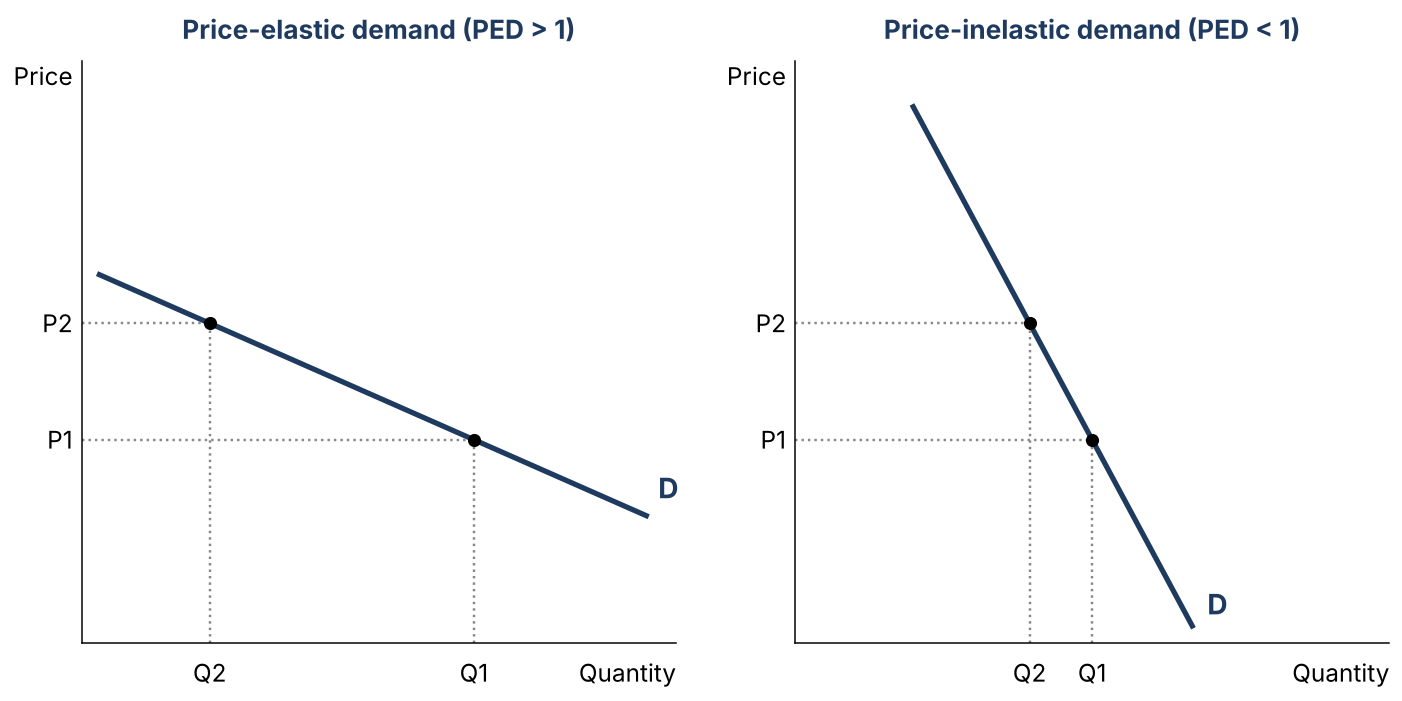
fall when it is inelastic
| Factors making demand more price elastic | Factors making demand more price inelastic |
|---|---|
| Many close substitutes | Few or no close substitutes; strong brand loyalty |
| Product is a luxury | Product is a necessity or habit-forming |
| Takes a large share of income | Takes a small share of income |
| Long time period — buyers can find alternatives | Short time period |
| Elasticity | Business decision it informs |
|---|---|
| PED inelastic | Raising price increases total revenue — useful when costs rise; price cuts would reduce revenue |
| PED elastic | Cutting price increases total revenue (if costs allow); raising price loses revenue — focus on differentiation and branding to make demand less elastic |
| YED high (luxury) | Expect strong sales in economic booms and sharp falls in recessions — plan capacity, inventory and product mix accordingly |
| YED negative (inferior) | Sales may rise in recessions — discount retailers often gain market share in downturns |
| PromED | Decide whether extra promotional spending is worthwhile, and which products deserve the marketing budget |
Fuel costs rise for an airline → airline estimates PED for business travellers as −0.4 and for leisure travellers as −1.8 → raises business-class fares, where revenue will rise → keeps leisure fares low, where a rise would cut revenue → price discrimination (Topic 3.3.4) protects total revenue
- elasticity values are estimates based on past data — conditions change
- the ceteris paribus assumption: in reality, many factors change at once (rivals' prices, incomes, fashion), so it is hard to isolate the effect of one
- elasticity changes over time and at different price levels
- competitors may react to a price change, altering the outcome
- obtaining reliable data through research or test marketing is costly
- 8.1.2 Product development
- 8.1.3 Sales forecasting
- Exam practice: 5 practice questions
- 2 exemplar answers with full model answers and mark breakdowns
- Where students commonly lose marks